Garry Kapoor
Senior UX Leader, Connected Buildings
AHUs to start, RTUs to schedule, lights to bring on for the floor that opens at 7. Site Manager strips the interface to the act itself — turn it on, turn it off, and configure the page to match the building you actually run, not the building the software was designed for.
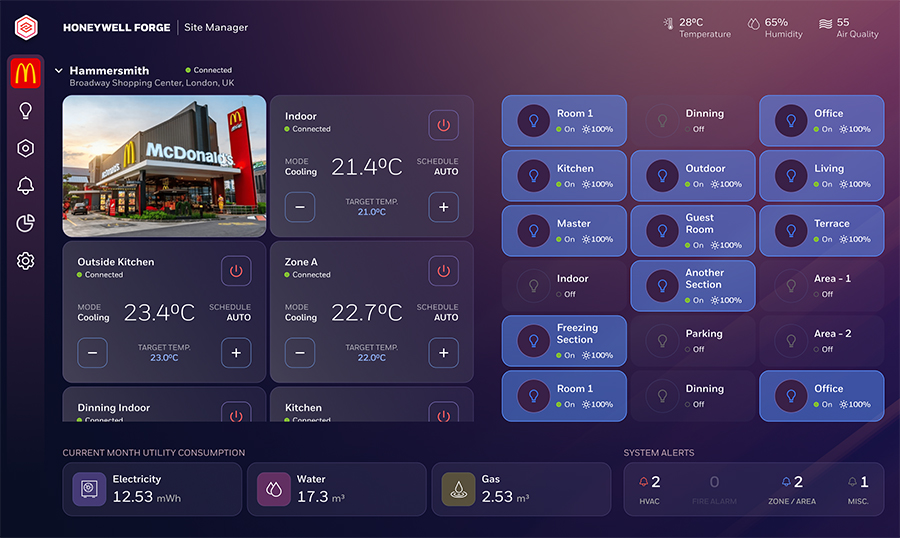
The site operator arrives with a sequence already memorized — which air handlers to start, which rooftop units to schedule, which lights to bring up for the floor that fills in an hour. The work is simple. The tool is not. Every morning, a person who knows exactly what to do has to translate that knowledge into a menu structure designed by someone who has never run a building at dawn.
Generic HMIs assume a generic building. But every site is its own machine — its own equipment, its own floors, its own rhythm of when spaces wake up and wind down. When the interface reflects the vendor's idea of a building instead of the operator's real one, every routine task becomes a small act of translation. Multiply that by every morning, every operator, every site, and the cost is enormous — paid in attention that should have gone to the work, not the tool.
The design removes everything between the operator and the thing they came to do. Turning equipment on and off is a single, direct gesture — not a path through nested screens. State is unambiguous: what is running, what is scheduled, what is off, readable at a glance from across the room. And the page itself bends to the site, so the operator builds the view around the building they actually have.
Turn it on, turn it off — directly, with no path to remember and nothing to fight.
Running, scheduled, or off — legible instantly, even at 6am with the lights still down.
The operator shapes the page to match their site, not the vendor's idea of one.
Bring a floor on before it opens; wind it down when it empties — on the building's rhythm.
If the operator has to translate intent into navigation, the design has already failed them.
The page matches the building you run — because no two sites are the same machine.
On, off, scheduled — never a guess. Certainty is the floor, not a feature.
Every element earns its place against the 6am task, or it isn't on the screen.
By collapsing the morning routine into direct on/off actions and letting operators configure the page around the building they actually run, Site Manager turned a daily act of translation into a few deliberate gestures. The interface receded — and the operator's own knowledge of the building became the fastest path through it, instead of the thing the software kept getting in the way of.
Site Manager doesn't ask the operator to learn the software. It learns the building they already know.