Garry Kapoor
Senior UX Leader, Connected Buildings
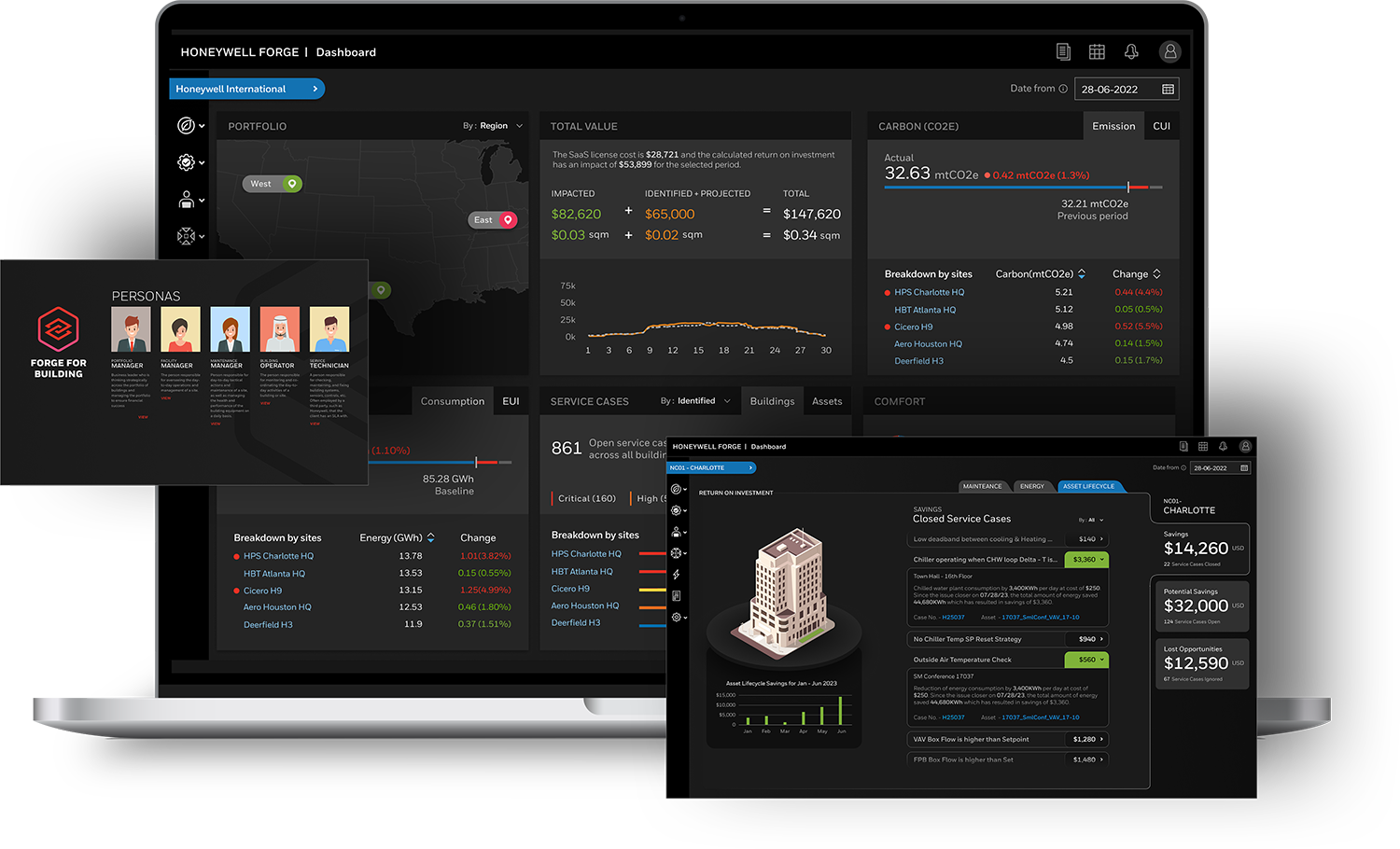
They need an answer, not a spreadsheet. The ROI Dashboard turns operational telemetry into a story they can carry into the room — identified, realized, lost, and projected savings, separated cleanly enough to defend each number across the table.
"I want to assess how a fault identified by 'The Solution' affects energy costs, so I can better prioritize my tasks and clearly demonstrate my role in achieving energy savings." The impact of a fault is determined by recognizing that the system catches issues often missed until much later in standard maintenance cycles — detecting and resolving inefficiencies early to achieve measurable, defensible savings.
Total faults and comfort level were never explained. Customers assumed they followed a standard like ASHRAE — but couldn't tell.
Faults were generated from 200 pre-defined rules, all enabled by default — burying the system in noise too large to clear.
Technicians were assigned faults, but managers had no sense of the return on fixing any one of them — so faults were ignored by default.
The distrust started with numbers nobody could trace. So before designing a single screen, I reconstructed how the system actually derives cost and comfort into one data-flow map, then walked Offering, Product, and Engineering through it together — until the fix each team signed off on was provably the same fix. That shared map, not a deck, is what kept three teams pointed at one outcome.

I proposed a solution where the user can see the logic behind how each cost is calculated, and added KPIs that clearly separate identified, lost, projected, and realized savings across Energy, Asset Lifecycle, and Operational dimensions — so every number can stand on its own the moment a customer questions it.

The logic behind every saving made transparent — trust restored at the source.

One building's story — identified, lost, realized, and projected savings, defensible line by line.
By giving every figure a visible origin, the dashboard turned numbers the customer had quietly stopped trusting into ones a facility manager could carry into a quarterly review and defend line by line. The single-site model proven here is what later scaled up into the Connected Buildings portfolio view.
Not a spreadsheet to defend — an answer to bring into the room.